

What time does the Thai-Chinese train arrive in Nong Khai?
" The train will go to Korat... How many lifetimes will it take to reach Nong Khai ?" It is a simple sentence that the researchers wanted to use to reflect the voices of people who question the progress of the Thai-Chinese railway construction, implying the project's delays and looking ahead to an uncertain future for this Mekong border city.
According to the goal of the Thai-Chinese high-speed railway construction project, which is a route connecting the three countries from Kunming to Bangkok, the construction of the railway in Laos has been completed and opened for use since December 2021, while the construction in Thailand is divided into 2 parts: the construction project in Phase 1 from Bangkok to Nakhon Ratchasima (Korat), and Phase 2 is the channel from Nakhon Ratchasima to Nong Khai. Currently, the construction of Phase 1 is still underway, while the construction of Phase 2 has not yet started.
The research team of the China-Thailand Cross-Border Railway Research Project had the opportunity to travel to Nong Khai Province and talk to local residents. The village headman of Nong Kom Ko provided information to the research team that the railway construction project had not actually been expropriated, and there were no letters or orders. The expropriation that occurred in the community was a road construction project, which was the route to Natha Station. The Natha Railway Station Development Project was to develop the area into a Container Yard, Transshipment Yard, and Depot to support the transfer of imported and exported goods from the China-Laos-Thailand high-speed railway, the double-track railway, Khon Kaen-Nong Khai section. The current Natha Station is just a small wooden house, which is a point for loading and unloading goods. In the future, this part of the Natha Station itself will be adjusted to be a future hub for rail freight in ASEAN. As for the expropriated area, some people have started to know which houses or land must be expropriated. Initially, there were not many people who had their land expropriated, and most of the land in the area had changed hands to capitalists a long time ago. The village headman also commented that most people were still waiting for the expropriation. At the same time, the locals knew very well how large the project was. Although there has been no clear announcement of when the project will start construction, villagers who still have some capital have purchased land that was expected to be expropriated 6-7 years ago as an investment in the hope that when the expropriation occurs in that area, they may be able to make a profit from this investment.

The construction of this road is to pave the way to the new Natha railway station in the future. Natha station is divided into a cargo area, which must be prepared for import-export, cargo transfer, cargo inspection point, and various ceremonies. Another part is a maintenance area. The road that is being constructed is the route from Highway No. 2 to Natha station. The road construction distance is approximately 1.010 kilometers. There is an expropriated area of approximately 28 rai (22 plots). There are approximately 15 buildings and structures that have been expropriated. The project budget is approximately 91 million baht.

In addition to the Natha Station development project, there is also a project to construct a new Nong Khai-Vientiane Friendship Bridge, which is being constructed 30 meters away from the original bridge. There are two initial designs in total.
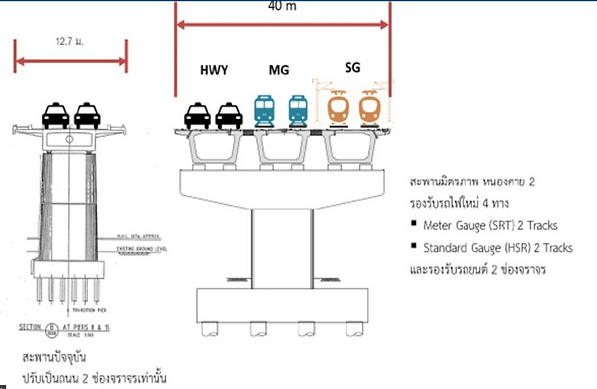
Option 1: Construct a new railway bridge and car bridge downstream of the original bridge. The construction will be a four-way railway bridge (Meter Gauge (SRT) 2 Tracks + Standard Gauge (HSR) 2 Tracks) and a two-lane car bridge, while the original bridge will be renovated to be a car-only bridge.
Image source: MGR Online. 2022. The Highways Department has spent 40 million baht to sign a contract to study the design of a new Mekong railway bridge connecting Nong Khai and Vientiane. Accessed from
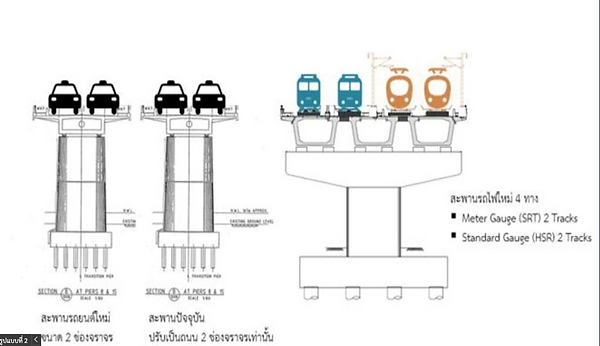
Option 2: Build a new railway bridge downstream of the current bridge, building a 4-track railway bridge (Meter Gauge (SRT) 2 Tracks + Standard Gauge (HSR) 2 Tracks), and renovating the current bridge to be a car-only bridge. Build a new car bridge upstream of the current bridge with 2 more traffic lanes, combined with limiting the traffic lanes of the original bridge to 2+2 = 4 traffic lanes.
Image source: MGR Online. 2022. The Highways Department has spent 40 million baht to sign a contract to study the design of a new Mekong railway bridge connecting Nong Khai and Vientiane. Accessed from
The bridge construction project has started to call a meeting to talk to the people of Ban Chommani, Tambon Michai, Mueang District, Nong Khai, regarding the expropriation of a total of 3 times. The research project talked to the abbot of Wat Chommani, which is one of the areas that will be expropriated. The abbot explained that around 2021, officials came to ask to stop the construction of the new temple hall. The temple had already put up the pillars of the building. The officials informed that a new Friendship Bridge would be built, which would occupy part of the temple area. When walking to the back of the temple, we found 5 more houses of local villagers. Mae Ueng, one of the residents, said that she had lived here for a long time. Before this, there were many people living in this community. Some of the residents who disappeared due to the expropriation when the Friendship Bridge was first built. About a year ago, officials came to talk to her and said that they had to move out because the area was an expropriated area. Mae Ueng commented that she had lived here almost all her life. If only part of this house was expropriated, she intended to continue living in this house even though there was only a small amount of space left. But if the whole area was expropriated, she only wanted a reasonable price assessment because the prices of land and houses in Nong Khai are quite high. Finding a new place to live may not be easy. As for Mae Ueng, she is a patient with physical limitations in walking and moving. Mae Ueng lives at home with her grandchildren who are still studying, which causes her to be concerned about many things, especially the issue that the project has not yet provided the details of the price assessment to the local people. This has created concern among the local people, including the abbot of Wat Chommanee, who is also concerned that the area to be expropriated may create a wider impact covering a larger area of the temple than expected.
From the survey of Nong Khai Province, the research team found that there was progress in various projects that were infrastructure to support the Thai-Chinese high-speed rail, such as improving the main roads. However, there was still no clear progress for this high-speed rail project. The construction work in Phase 1, Bangkok-Korat, had progressed by 28.61% [1]. The construction work over the past 6 years has been full of obstacles and challenges. Meanwhile, the construction project in Phase 2, which will be the route from Korat to Nong Khai, still has no sign of starting construction. People in the area have various imaginations, feelings, and preparations to deal with this uncertain project. Some are waiting to see if they will be expropriated, while others have to prepare plans for evacuation or wait to see changes in their area. Even business groups are waiting and preparing to develop so that their businesses are in line with the development that will occur.
[1] Daily News. 2023. End of 6th year…with 28% completion. The first high-speed train line in Thailand will reach its destination on 1 February 2024. https://www.dailynews.co.th/articles/3002611/


* I would like to thank the abbot of Chommanee Temple, the staff at the railway station, the village headman of Nong Kom Ko, Phi Kung, and other people in Nong Khai Province who kindly took the time to provide information to the research team.
** This work is part of the research information dissemination activity to the public under the project "Cross-border China Railway: A Comparative Study of the Impacts of Railway Construction Projects on Communities Around Main Stations in Thailand and Laos", funded by the Office of the Higher Education, Science, Research and Innovation Policy Council (NSTDA) by the Human Resource Development and Institutional Development Fund Management Unit (NHRC) for fiscal years 2021 - 2023.
*** The research project is currently underway. The published content is part of the data collection and is not a conclusion of the research results.