
STORIES from the Ground
Dream of Thai-Chinese High-Speed Rail: Community, Problems and Design
Case study of Ban Mai Subdistrict Community, Korat
China-Thailand Railway
The opening of the China-Laos high-speed railway in late 2021 reflects the so-called “dream to reality”. This is the fact that Laos, a landlocked country, has been developed into a land-linked country that connects transportation routes through modern infrastructure. No matter how much resources are lost during this investment, the image of Laos’ development has definitely changed, and the Thai people who are waiting for their own high-speed rail have become clearer.

Photo by Kaikeo Saiyasane/Xinhua
Image source: http://www.news.cn/english/2021-12/03/c_1310350185.htm

The construction of Thailand's high-speed rail route is divided into two phases: Phase 1 (Bangkok-Korat) and Phase 2 (Korat-Nong Khai). Currently, construction of Phase 1 is underway. The government has gradually signed construction contracts with various companies. There are several contracts. Some have already begun construction, while others are under contract. Some have also been suspended due to other issues, such as the lawsuit against the bidding results for the civil works contract for the Kaeng Khoi-Klang Dong section and the Pang Asok-Bandai Ma section, a length of 30 kilometers, and the adjustment of the Ayutthaya station design due to concerns that it will affect the scenery and the World Heritage status. As mentioned, these are the issues that show that the government is facing difficulties that it must manage in order to achieve the important goal of completing the construction on schedule.
However, from the government's perspective, the construction of this large-scale structure will be a tangible achievement that will create history, which may require a budget, taxes, space, or even the sacrifices of those directly affected. But for those affected, the construction of this large-scale structure may become a nightmare that they will have to face for the rest of their lives.
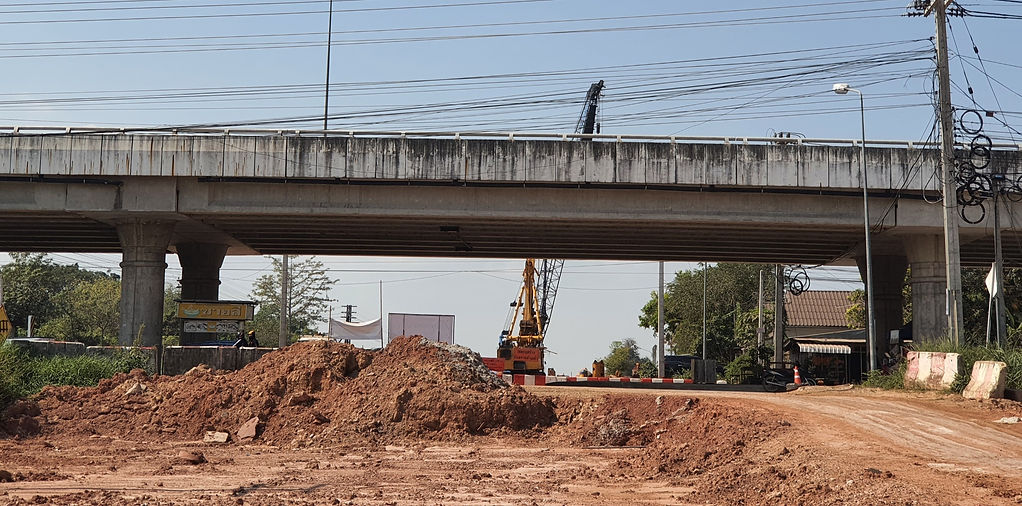
Ban Mai Subdistrict Community, Mueang District, Nakhon Ratchasima Province is one of the areas that is being affected by the design of the Thai-Chinese high-speed railway. It is located in the area of construction of Contract 3-5, civil works for the Khok Kruat-Nakhon Ratchasima section. The railway route that cuts through is designed to be a raised embankment for a distance of 7.85 kilometers.


According to locals, the shape of the embankment will divide the community into two sides, causing great inconvenience for the people in the community, which has a population of more than 40,000 people in the area, and may cause problems with safety of life and property, and many other problems.
The community members noticed that the railway line before entering the Ban Mai community was designed with high pillars. Some areas are cassava forests with no communities. They can design high pillars to cross over. However, in the Ban Mai area, it is an earthen embankment that stretches along the community area and returns to the high track as pillars again in the area of the Korat city station. There are only a few tunnels to travel across the river. This makes the people in the Ban Mai community feel that this design is unreasonable and will cause problems in their lives.
In addition to the design problems, since the construction land was cleared, the locals said that the area was originally a basin. Normally, during the rainy season, the water would flood to knee level and would dry up in a few days. However, after the construction of this project began, the water level rose to a meter and drained more slowly than before. This observation is what the locals think, if these problems still occur now, in the future, when the construction is completed and the embankment with a train running across it, the flooding problem may become more severe. How will they live?

From seeing these problems, the Ban Mai Subdistrict Community Development Group 2020 was formed with the aim of solving the problems of Ban Mai people. Past work has been driven by providing information to people in the community about the impacts and collecting data, as well as submitting letters to relevant agencies such as the State Railway of Thailand, the Ministry of Transport, the provincial governor, the Senate committee, etc.

The demands that the group and people in the community jointly signed to ask the government and relevant agencies to make corrections include changing the design from the original solid high earthen wall along the entire length of Tambon Ban Mai to
Elevation of piers, lifting from Khok Kruat Subdistrict and Ban Mai Subdistrict
After the research team went to the area to talk with the group members, they also found an important issue:the problem of the process of hearing opinions in the Environmental Impact Assessment (EIA). Before the construction of this high-speed rail, the group members reflected that the public, who are directly involved, have never been able to fully participate in expressing their opinions, and do not feel that they have received detailed and sincere information on the construction process or steps from the relevant agencies.
"I want prosperity, but I don't want damage to the people."
" I've been holding it in for a long time. I went to a meeting with the train. I wanted to speak that day, but they stopped me. They didn't give me any time. I could only speak. Then they said that was enough. I felt uncomfortable because my family has been divided into two parts since I was born. It's not right. And you've never asked the people if they're suffering. You suddenly brought it down. I have to struggle for the people."

"Most of our community use motorcycles to go to work in factories and they have to travel through tunnels. Do you think it will be dangerous? Because a girl rides a motorcycle alone. But if we are an open area with bright lights, we don't know when the lights will go out in the tunnel or when the water will flood. And the child, our daughter, who works the night shift, how will she get there? Will there be a lot of thieves? They don't take that into account."
"When conducting EIA in our country, they usually invite people to discuss at hotels, and there are only a few people... and then they show a slide. I'm confused. To be honest, I can't imagine it. Actually, EIA has to come down to the area to get information about the terrain and how the people live. We don't have this..."
"Every time there is a seminar, but there is no review of the information returned. I don't know if there is information that we talked about last time. Did we have anything to say in the public hearing? I feel that we don't know the results of the previous meeting."
"The company that came to do the EIA, they invited them to the center. The time for the community meeting started at 9 am and then the governor came to open it and the railway came to explain the engineering process. It took a lot of time. Then the impact that occurred was opened for the people to ask questions for half an hour. It was over at noon and they had lunch and went home. Therefore, there was no clear answer."
The Thai-Chinese high-speed rail project is under construction amid a backlash from the Ban Mai community asking for a construction plan that is more suitable for their way of life. Group members reiterated to the research team that they are not against the high-speed rail project in Korat Province, but rather want to move for a construction plan that takes into account stability, safety, and friendliness to the lives of nearby residents.
The case of Ban Mai community is one example that reflects how the planning, design and consultation process are very important for the development of infrastructure that leads to positive social outcomes and does not exclude anyone from the benefits of the project.
***

* This work is part of the research information dissemination activity to the public under the project "Cross-border China Railway: A Comparative Study of the Impacts of Railway Construction Projects on Communities Around Main Stations in Thailand and Laos", funded by the Office of the Higher Education, Science, Research and Innovation Policy Council (NSTDA) by the Human Resource Development and Institutional Development Fund Management Unit (NHRC) for fiscal years 2021 - 2023.
** The research project is currently underway. The published content is part of the data collection and is not a conclusion of the research results.

Phanitda Saiyoras
Project Leader

Plaifha Namphrai
Research Assistant

Vishnu Duangpan
Research Assistant